Wednesday, December 18, 2013

Women Fashion Differences

    Women in the Byzantine and Islamic empires dress differently, but the clothing represents the same things in both empires. The Islamic source that will explain the differences is, Women listening from the gallery. Image from the Maqāmāt al-Ḥarīrī. MS Arabe 5847, fol. 58v, detail. Bibliotheque Nationale,Paris.  The Byzantine Empires’s painting is Portrate of a Women in a White tunic. These pictures show the difference in the amount of clothing, the color of clothing and  the difference in why the garment was worn. 

The primary sources are:
Islamic Empire: It is a painting of seven women listing in the gallery. They are all sitting and they all have parts of their faces covered. They all have a lot of cloth around them, covering their entire bodies. This garment is like a cloak, one rectangular piece. Some of the women may be wearing jewelry, others are not.  Most of them have their mouths covered and the rest have their eyes covered. The second and third women from the right look like they are richer because the print is richer and they are wearing more jewelry.  All the women are not smiling. The colors of the wraps are green, yellow, blue or red.

Maqāmāt al-Ḥarīrī. MS Arabe 5847, fol. 58v, detail. Bibliotheque Nationale,Paris.
The Byzantine Empire is a portrait of a woman wearing a loose, white tunic with a boat shaped collar. The women is wearing hoop earrings with small pearls. Her head and face is not covered to show that her hair is parted in the middle and pulled back. There is a burnt red strap on her right shoulder. According to my research, from an article by Dawn Vukson - Van Beek, the woman's tunic tells us that she is of the lower class. The tunica was the underclothes in the winter and sometimes the actual garment in the summer. It normally would have been warn under a stola, which is like an over coat.

Portriat of a Woman in a White Tunic
Outline:
1. The Islamic women are more confined in what they have to wear, like having to be complacently covered     up.
     a) Why this type of clothing, and why wear it like that?
            ii. The Norm: It was normal for women to cover themselves and submit themselves to men. In some                   places in Turkey, women were held higher than men, and to travelers, it seemed unnatural. The                     women in the painting had their faces covered form the men in the gallery.
     b) How does the clothing show class and wealth?
            i. Jewelry: The jewels on women 2,3, and 6 bodies and clothes indicated that they were of a higher                 class, because they can afford the jewels. In the Medieval time, jewelry was mainly for the men, but               the richer women could wear it as well.
           ii. Cloth Patterns: The patterns on the cloth was more elaborate, meaning more expensive on women                  2,3, and 6, also showing that they were of a richer class than the other women.

2. The Byzantine women are much more freer in the type of garment, because they do not have to cover           their faces and can be seen in public in a tunic, or essentially an undergarment.
      a) Why this type of clothing, and why wear it like that?
            i. Versatility: Tunics were the Byzantine people's staple garment, much like our pair of jeans. Made                  either of fine wool, silk or linen. They were the underclothes for the rich or the common for the                      poor or working class.
           ii. Comfort: Most always the tunic was white, making it cooler in the Mediterranean heat.                                 Occasonaly, the tunic would be sleeveless, also to make it cooler. It would normally go under a                     stola, or embellished over coat, for the richer people.
     b) How does the tunic show class and wealth?
           i. The material: If it was made of silk, the wearer was probably rich. The tunic in the painting is                         linen, or fine wool showing that the woman is of the lower class.
           ii. The style: The more embellishments that are on the tunic, the richer the person is. So, because there                are no trimming, the women was lower class. Also, if the tunic is being warn as an undergarment,                  then there is a stola, which is not present.

3. The Byzantine women are more freer, than the Islamic women based on the style of clothing, but the             clothing is used as a symbol of wealth in both Islamic and Byzantine cultures.
      a) Why Byzantine are freer.
            i.  No head coverings: The Byzantine women do not have to have their heads and faces covered up.                 In the Byzantine empire, it was very rare for a woman to wear a hat, or anything on her head.
            ii. Bodily  Coverage: The Muslim women had almost every inch covered up, but the tunics could be                  sleeveless, leaving the arms exposed, along with the neck because of the boat shaped                                    neckline.Unlike the Muslim women who had their necks covered as well.
      b) How they are similar
            i. They represented wealth: If a woman had a more expensive fabric, like silk, or a more elaborate                    fabric, then the woman was most likely from the upper class.
            ii. If a woman had more jewelry, or more embellishments, signified a wealthier class.

Works Cited
Vukson-Van Beek, Dawn. "Byzantine Costumes." N.p., n.d. Web. 19 Dec. 2013.                        <http://library.thinkquest.org/04oct/01181/Byzantine%20costume.pdf>.
"Women in Islam: Muslim Women." Women in Islam: Muslim Women. N.p., n.d. Web. 19 Dec. 2013. <http://islam.uga.edu/Islamwomen.html>.
Al-Kaslaania, Samia. "Sayyeda Al-Kaslaania's Fatimid Arts." : Medieval Islamic Cloak-type Wraps:Material Culture Fourteen: A&S 50 Challenge. N.p., 29 Mar. 2010. Web. 19 Dec. 2013.                 <http://idlelion.blogspot.com/2010/03/50-challenge-material-culture-fourteen.html>.
Mann, Horace. "Part I: What Do the Qur'an and Hadith Have to Say about Muslim Clothing?"Muslim and Middle Eastern Clothing, Jewelry, Make-up. N.p., n.d. Web. <http://www.hudsoncress.net/hudsoncress.org/html/library/nonfiction/Islamic%20Clothing.pdf>.
Portrait of a Woman in a White Tunic. 4th Century. Photograph. Joseph Brummer Gallery, New York.
Women Listening from a Gallery. 5847. Photograph. Bibliotheque Nationale, Paris.

Religious influences on social classes in the Byzantine Empire and Islamic Civilazation


I. Religion is a topic that many wars have been fought over and break bonds that you once thought was inseparable. Religion is though to be a way of life, but some cultures choose to eliminate public displays of religion to keep tension to a minimum. The ancient Byzantine Empire displays this in a very public way, social class. This empire wants to focuses on more important things; money and political standings. On the polar opposite site we have the Islamic civilization whose citizens' daily life revolves around their religion. The social class system of the Islamic civilization was solely determined by religious status, one’s religion determined their social standing; while Byzantine social hierarchy was based on economic and political factors, one’s monetary wealth and ministerial influence.

II.  Islamic Social Structure
               A.  The Islamic social hierarchy was only constructed around Islam.
                            1. How the classes were divided
                                         a. Birth into Islam, converted, protected people, non-muslims
                            2. Acceptance towards other religions
                                         a.   Primary Source:
                                                 1. According to the Sahih International, the Quran, 2:62, says The people who are actively practicing Judaism, Christianity, and Seboghatullah should not be punished for not following the Muslim ways. For the people who did follow Allah will be rewarded. They will not be rewarded with material things, but with the grace of Allah. Their lord's grace shall bless them, and they will not feel pain or sorrow.
                                         b. Expected people to follow the Quran during daily life
                                         c. Peaceful society
II. Byzantine Social Class
                 A. The Byzantine Empire focus their social structure on money and political standings instead of religion.
                            1. How the Classes were divided
                                          a. Top, Senatorial Class-has at least one noble in the family, someone who has served in the Senate before, Equestrian Class- Had a stable income,land worth 400,000 sesterces, Family was also considered Equestrian also, Commons- Born a citizen, lower class,Foreigners- Lived in the territories,Freed People- people who used to be slaves but not anymore, and Slaves
                             2. Separated the top classes from the bottom
                                           a. Law that divided Romans into two groups, the honestiores more honorable people including senators, equestrians, and soldiers and the humiliores more insignificant people including all other groups
b. Clothing represented social class
i. Primary Source-
 
                                                 In this mosaic,there are four men dressed in white long robes, but with different garments on top of the white. The men are surrounding a haloed man wearing purple. The remaining four men look to be serving the purple roped man. According to Dr. Steven Zucker, Justinian I is wearing a purple robe and is crowned with a halo. He is surrounded with members of the church and the Bishop Maximianus of Ravenna. On the left of the painting you can see men wearing a white rope with a purple stripe across their torso.The painting represents the "Central Position of the Emperor between the power of the church and the power of the imperial administration and military." It re-enforces the idea that Justinian I has power over the religion, military, and country.
                                                                   ii. Purple Signified Emperor and Stripes signified Soldier

Work Cited:
McManus, Barbara F. "Roman Social Class and Public Display." Roman Social Class and Public Display. The College of New Rochelle, Jan. 2009. Web. 18 Dec. 2013. <http://www.vroma.org/~bmcmanus/socialclass.html>.
Rautman, Marcus Louis. Daily Life in the Byzantine Empire. Westport, Conn. [u.a.: Greenwood, 2006. Print.
"Surat Al-Baqarah." Surat Al-Baqarah [2:59-65]. University of Copenhagen, Nov. 2007. Web. 19 Dec. 2013. <http://quran.com/2/59-65>.
Zaheer, Khalid, Dr. "Qur’an: The Primary Source of Islam." Qur’an: The Primary Source of Islam. N.p., n.d. Web. 19 Dec. 2013. <http://www.renaissance.com.pk/janqur99.html>.

Byzantine and Islamic Art and Religion


The Byzantine Empire and the Islamic religious cultures are similar and different in several different aspects. In the Byzantine Empire, they incorporated art into their religion by using very elaborate decorated crosses in imperial processions, and even in the military. The Islamic peoples also used art in their religion, but they mostly were paintings of significant events in their religion. The Byzantine Empire focused on using their crosses and religious art in imperial processions and in the military, but the Islamics used their art in their religion mainly with paintings of significant events in history of the religion.

The Byzantine Cross is extravagantly decorated with silver and gold busts of Christ, the Virgin Mary, the Mother of Christ, John the Forerunner, and Michael and Gabriel (the guardian angels of heaven). The bust of Christ is placed in the center, and the rest of the figures are placed on each end of the cross. These were very important to the Byzantines and the Christian religion during that time period.
The Islam painting is of Muhammad's Call to Prophecy and the First Revelation. The writing around the picture, it explains that the angel is Gabriel, and he is in God’s presence being told to send a message.
  1. The Byzantine Empire used crosses and their religious arts in military, and imperial processions.
    1. Their crosses would also be used as donations to cure sicknesses and purify water.
      1. Saints are mostly the ones who used these type of crosses in imperial processions and other ceremonies.
    2. The crosses would be taken with the military when they went of to war. It would be used as a “protector”, or it could be used if one of the soldiers became ill or wounded to help them get better.
    3. These crosses were very important to the Byzantine Empire, their religion, and had a major effect on how the Byzantine people they lived their lives.
  2. The Islamic people used art in their religion with mostly paintings of significant events.
    1. The Islam religion did not use art in any religious ceremonies or imperial processions like the Byzantines did.
    2. Instead, they have several historic paintings that honor their Allah.
      1. These painting could also be used to teach others about their religion and to keep the Islamic religion in their minds.
    3. The Islamic did not use their art in religious ceremonies like the Byzantines, but they had other ways that their religion related to their art.
  3. Even though the Byzantine Empire used art more with their religion than the Islamics did, they still both had some similarities.
    1. Both of the religions used their form of art to honor their God and to help keep the religion in their minds.
  4. The Byzantine Empire over all incorporates their art and religion more and in different ways than the Islamic Culture.


Works Cited
"Heilbrunn Timeline of Art History." The Birth of Islam. N.p., n.d. Web. 17 Dec. 2013.
"Heilbrunn Timeline of Art History." Processional Cross [Byzantine] (1993.163). N.p., n.d. Web. 18 Dec. 2013.
"404." 404. N.p., n.d. Web. 18 Dec. 2013.


Roshni Patnayakuni

Women's Clothing:

Islam vs. The Byzantine Empire    
       In  Islam, modesty was an important trait, especially in women; In the bible it says that it should be for Christian women as well though for different reasons. In the Qu'ran it demanded modesty to avoid being risque, while in the bible it spoke of humility and self-control to let your inner beauty shine through. Though still, despite the similarity in rules, the clothing was actually quite different; the dress code of the Muslim people was much stricter than that of the Byzantine Empire. This shows that religion was taken much more seriously in Islam than in the Byzantine Empire.

Paraphrasing:

“O you Children of Adam! We have bestowed on you raiment to cover your shame as well as to be an adornment to you. But the raiment of righteousness, that is the best. Such are among the Signs of Allah, that they may receive admonition.” (Quran 7:26)
“And say to the believing women that they should lower their gaze and guard their modesty; that they should not display their beauty and ornaments except what must ordinarily appear therof; that they should draw their veils over their bosoms and not display their beauty except to their husbands, their fathers, their husbands’ fathers, their sons, their husbands’ sons, their brothers, or their brothers’ sons or their sisters’ sons, or their women or the servants whom their right hands possess, or male servants free of physical needs, or small children who have no sense of the shame of sex, and that they should not strike their feet in order to draw attention to their hidden ornaments…” (Quran 24:31).
            
These chapters in the Qu’ran basically states that they have clothing therefore it should be used to exercise modesty. Though it can be a decoration a worshipper’s religion is be the best  embellishment. It also says that women should “guard their modesty” by not showing their bodies or any additional adornment besides the necessary basics. They should wear scarves that cover their heads and drape all the way down to the neckline on their clothes to hide the neck and collar area as well. There are only select people who they don’t have to where this outfit in front of: their parents, their siblings, their children, their sibling’s children, their in-laws, small (innocent) children and certain servants. As well, they must not stomp to bring awareness to the jewelry they wear under their clothes

likewise also that women should adorn themselves in respectable apparel, with modesty and self-control, not with braided hair and gold or pearls or costly attire,  but with what is proper for women who profess godliness—with good works. (Timothy 2:9-10)
Your beauty should not come from outward adornment, such as elaborate hairstyles and the wearing of gold jewelry or fine clothes.  Rather, it should be that of your inner self, the unfading beauty of a gentle and quiet spirit, which is of great worth in God’s sight. (Peter 3:3-4)
…. and be clothed with humility: for god resisteth the proud, and giveth grace to the humble.

In the bible it says that women should dress “with modesty and self-control” meaning they shouldn’t wear revealing clothes or clothes or jewelry with excessive embellishment; Christian women should do this so that their inner beauty (AKA their sparkling personalities) will shine through.  It says that god blesses the humble, not the vain.

Outline:

  • Introduction( see opening paragraph)
    • Despite the regulations about modesty in the religious texts of both Iran and The Byzantine Empire, the dress code of the Muslim people was much stricter than that of The Byzantine Empire. This shows that religion was taken much more seriously in Islam than The Byzantine Empire.
  • 1st Paragraph: Religious Clothing in Islam vs. Real Clothing in Islam
    • very similar
      • wear their veils properly and conservatively
      • wear dull colors: modest colors
      • hide ornamentation under clothing
  • 2nd Paragraph: Religious Clothing in Byzantine vs. Real Clothing in Byzantine
    • rule bending/ possible breaking
      • bright colors
      • some adornment
      • wore headscarves but much looser and less constricting
      • interest in fashion
  • Conclusion
    • what is actually done in Islam was very close to what was demanded in the Qu'ran, while in the Byzantine empire, the clothes that were worn were very different from the rulings of the bible.
    • therefore the rulings of religion are taken much more serious in Islam than in the Byzantine Empire.

Works Cited:
Robinson, Scott. "Romanesque/Byzantine."Romanesque/Byzantine. Central Washington University, 1 May 2002. Web. 18 Dec 2013
       <http://www.cwu.edu/~robinsos/ppages/resources/Costume_History/romanesque.htm>.


Role of Byzantine and Islamic Women


                                            Role of Byzantine and Islamic Women

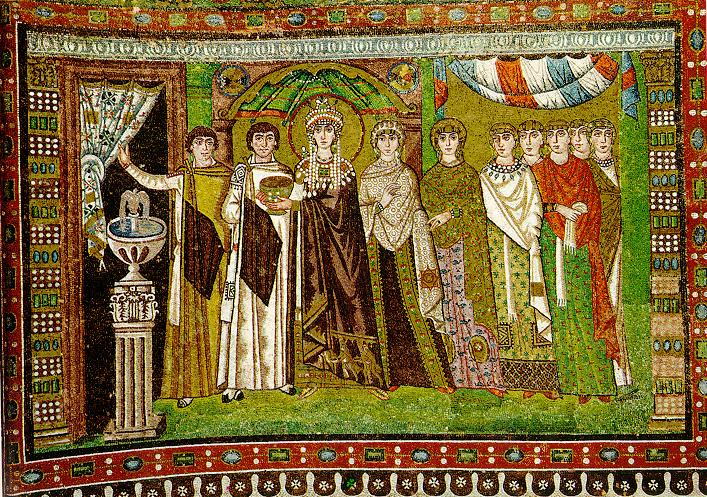
Throughout history, the role of women has been vital in shaping civilizations. Men, however, have always seemed to have superiority over women. The women of the Byzantine and Islamic civilizations were treated with decency and respect despite the common stereotype of men having control over the women. In the Islamic civilization, the Qur’an states numerous times that women should be treated with civility. The Qur’an especially highlights it well in section four verse nineteen. In the Byzantine civilization, the mural titled “Theodora and her Retinue” highlights the equality women have with men. The Byzantine and Islamic were treated with decency because their opinions were heard, and they had the opportunity to be something more than just house wives.

In the Islamic religion, the Qur'an serves as the essential guide to everyday life. All Muslims who practice the faith must follow it .According the Qur’an in section four verse nineteen it states: If you believe this, know that you are prohibited to inherit women if they do not want to be married to you. Your also are not supposed to treat them harshly and as if they are inferior. Allah does not want you to patronize the women, but treat them with kindness. If you hate your wife, you hate what Allah has deemed as good. It reiterates that women are not to be inherited. Unless the women are guilty of infidelity, then you need to treat them with affection. Again it reestablishes that if you hate your wife then you hate something that Allah has deemed good. Primary Source

Empress Theodora and her Attendants
In the Byzantine culture, they liked to express certain aspects of their way of life through artwork. Theodora was an important figure in shaping the lives of women because she was married to the Byzantine emperor Justinian. In mural entitled "Empress Theodora and her Attendants” there are seven women who are perceived as her ladies in waiting on her left and two men on her right. The mural makes Theodora the main focus by making her in the center. Theodora is wearing a purple robe which is a sign of royalty and of a respectable stature. According to Stan Rummel, a history professor at Texas Wesleyan University, the purple robes were usually only worn by men of a high social ranking such as her husband Justinian. This is significant to women because it symbolizes that women are equal with men. She has a halo around her head which symbolizes power. This was an empowering symbol to the Byzantine women because it gave them a sense of equality. Primary Source


Byzantine and Islamic women in everyday life

          I. Theodora was responsible for majority of laws favorable towards women.

                      a. made trafficking among girls and women illegal
                      b. made laws to give women more benefits in divorce
                      c. she regularly took time to visit with the common women to find out what she could do to better their lives
Theodora the voice of the women because she made their opinions known and found ways to help them have better lives.

          II. Muhammad's wives were a key part of the Islamic culture, Khadijah bint Khuwaylid, his first wife was viewed as the voice of the women.

                      a. made women have deeper knowledge of religion
                      b. helped women who were less fortunate 
                      c.  participated in political assemblies and suggested ideas benefiting women

         III. The Byzantine women not only took care of household, but they did separate activities 
                     a. ran businesses
                     b. participated in church activities

         IV. Since the Qur'an makes it clear that men should treat women with respect, many women wanted activate their right to do more that just raise a family.
                      a. participated in political assemblies


Works Cited

"Women in World History : MODULE 1." Women in World History : MODULE 1. N.p., n.d. Web. 14 Dec. 2013. <http://chnm.gmu.edu/wwh/modules/lesson3/lesson3.php?s=0>.

Connor, Carolyne L. "Women of Byzantium." N.p., n.d. Web. 14 Dec. 2013. <http://bmcr.brynmawr.edu/2005/2005-01-07.html>.

Hunt, Patrick. "Byzantine Art as Propaganda: Justinian and Theodora at Ravenna." N.p., n.d. Web. 18 Dec. 2013. <http://traumwerk.stanford.edu/philolog/2006/01/byzantine_art_as_propaganda_ju.html>.

Rummel, Stan. "The Express Theodora and Retinue. " N.p., 2007. Web. 18 Dec.2013. 
<http://faculty.txwes.edu/csmeller/humanexperience/ExpData09/03Biee/BieePICs/1ByzPICs/Ravenna/StVitale547/Theo01Ret497.htm>.

Fisher, Elizabeth A. "Women in the Byzantine Empire." N.p., n.d. Web. 15 Dec. 2013. <http://web.clark.edu/afisher/HIST252/Women%20in%20the%20Byzantine%20Empire.pdf>.

"Islams Women - Khadijah Bint Khuwaylid." Islams Women - Khadijah Bint Khuwaylid. N.p., n.d. Web. 16 Dec. 2013. <http://www.islamswomen.com/articles/khadijah_bint_khuwaylid.php>.

"Internet History Sourcebooks Project." Internet History Sourcebooks Project. N.p., n.d. Web. 18 Dec. 2013. <http://www.fordham.edu/halsall/basis/procop-anec.asp>.

"Women's Liberation through Islam." Women's Liberation through Islam. N.p., n.d. Web. 18 Dec. 2013. <http://www.islam101.com/women/womlib.html>.


Islamic Literature VS. Byzantine Literature

Coner McFarlin
12/19/13
History - block G
Primary source project - blog post


Literature was an important aspect of the Islamic and Byzantine cultures. People used literature to express ideas and share discoveries. When Islamic literature such as One Thousand and One Nights, or the Quran are compared to pieces of Byzantine literature such as writings of emperor Justinian, the structural and the ideational superiority of Islamic literature is evident. If literature was used as a window to look at each culture side by side, it would be evident that the Muslims progressed and learned at a much greater rate than the Byzantine people.


PRIMARY SOURCE BYZANTINE LITERATURE – Institutes, collection of Byzantine legal documents
We now come to another division relative to the rights of persons; for some persons are independent, some are subject to the power of others. Of those, again, who are subject to others, some are in the power of parents, others in that of masters. Let us first treat of those who are subject to others; for, when we have ascertained who these are, we shall at the same time discover who are independent. And first let us consider those who are in the power of masters.
1. Slaves are in the power of masters, a power derived from the law of nations: for among all nations it may be remarked that masters have the power of life and death over their slaves, and that everything acquired by the slave is acquired for the master.
2. But at the present day none of our subjects may use unrestrained violence towards their slaves, except for a reason recognized by law. For, by a constitutio of the Emperor Antoninus Pius, he who without any reason kills his own slave is to be punished equally with one who has killed the slave of another. The excessive severity of masters is also restrained by anotherconstitutio of the same emperor. For, when consulted by certain governors of provinces on the subject of slaves, who fly for sanctuary either to temples, or to the statues of the emperors, he decided that if the severity of masters should appear excessive, they might be compelled to make sale of their slaves upon equitable terms, so that the masters might receive the value; and this was a very wise decision, as it concerns the public good, that no one should misuse his own property. The following are the terms of this rescript of Antoninus, which was sent to Laelius Marcianus: The power of masters over their slaves ought to be preserved unimpaired, nor ought any man to be deprived of his just right. But it is for the interest of all masters themselves, that relief prayed on good grounds against cruelty, the denial of sustenance, or any other intolerable injury, should not be refused. Examine, therefore, into the complaints of the slaves who have fled from the house of Julius Sabinus, and taken refuge at the statue of the emperor; and, if you find that they have been too harshly treated, or wantonly disgraced, order them to be sold, so that they may not fall again under the power of their master; and, if Sabinus attempt to evade my constitutio, I would have him know, that I shall severely punish his disobedience.
PARAPHRASE:
This legislative writing, written by Byzantine emperor Justinian I, addresses the problem of slavery. Justinian suggests that while some people are independent, others must submit to their superiors. He then declares that slaves belong to their masters, and the masters have COMPLETE control over the slave’s lives. He does however go on to say no one may be extremely violent towards their slaves or punish them too severely. If a master is too harsh on his slaves, then he must sell them at a reasonable price, so that the general public benefits from the situation.


ISLAMIC LITERATURE PRIMARY SOURCE – Introduction to the Quran
1. In the name of God, Most Gracious,
Most Merciful.
The Cherisher and Sustainer of the Worlds;
And Thine aid we seek.
Thou hast bestowed Thy Grace,
Those whose (portion)
Is not wrath,
And who go not astray.

2. Praise be to God,
3. Most Gracious, Most Merciful;
4. Master of the Day of Judgment.
5. Thee do we worship,
6. Show us the straight way,
7. The way of those on whom


PARAPHRASE:
This is the introduction to the Quran, the religious book of the Islamic people, which was given to Muhammad by Allah, the god they believe in. This passage starts off pleading towards Allah, and is followed by praises directed towards Allah as well. These praises describe Allah as a nurturing, forgiving, and powerful god. Next, the writer states that he has worshipped Allah, and he seeks his help. He wants to live the way that Allah wants him to live, the path that will lead him to salvation. 

Link: http://www.sacred-texts.com/isl/htq/index.htm


OUTLINE

1) Intro to Islamic literature

     a) Islamic literature was highly diverse; it covered not only legal matters, but represented a wide range of ideas from religion, to legislative documents, to fictional works and folktales.


     b) Prose


          i) Most commonly used form of prose was called the maqamah. This was an elegant method of writing which rhymed, but was still considered prose.

     c) Poetry


           i) Five different types of poetry


               (1) Qasida 

                    (a) An ode of 20-100 verses, maintains a single end-rhyme throughout

               (2) Ghazel

                    (a) A short love lyric of 5-12 verses, meant to portray secular and/or religious ideas.

               (3) Qitah

                    (a) A form of poetry used to make jokes or for satire

               (4) Masnavi

                    (a) This is rhyming couplet. It was very popular because it allowed poets to tell a story by stringing thousands of verses together.

               (5) Roba’I

                    (a) Four line verse where lines 1, 2, and 4 rhyme.

     d) Transition

          i) All of these methods of writing culminated in unique and powerful literature. One example of the power of Arabic literature was One Thousand and One Nights.

2) One Thousand and One Nights

     a) The book One Thousand and One Nights was a collection of folk tales from all across Arabia, many of which were told by Persian Queen Scheherazade. 

     b) Literary Devices

          i) Frame Story

                    (1) A story in which the real plot is another story within a story

          ii) Embedded Narrative

                    (1) A character narrates a story about his/herself

          iii) Imagery

          iv) Foreshadowing

          v) Crime fiction and Horror elements

          vi) Science Fiction and Fantasy stories

          vii) Fate and Destiny

          viii) Humor 

     c) Importance

          i) These ideas were fairly new at the time, and if Islamic literature had not shaped them and improved so vastly upon them, modern literature would not be at the same place it is today.

     d) Transition

          i) Still, One Thousand and One Nights was not the only piece of literature that greatly influenced following years.

3) The Quran, the holy book of the Islamic people

     a) The Quran is one of the most unique books ever written. It does not follow any forms of Arabic poetry or prose and therefore is classified as neither.

     b) Religious influence

          i) This book taught Muslims to live how their god wanted them to live. It greatly influenced the religion and resulted in many more believers.

     c) Educational influence

          i) Because of the amazing uniqueness of the Quran, it has been studied for as long as it has been written. No piece of literature has been able to replicate the style of the Quran, since it does not fall under poetry or prose. 

     d) Transition

          i) While the Quran may be one of the most unique, universal, and influential pieces of literature, there were also pieces of Byzantine literature that remain noteworthy. 

4) Byzantine Literature Intro

     a) Byzantine literature was modeled after Greek Atticism, a rhetorical style of writing.

     b) Rhetoric

          i) Rhetoric is a very methodical writing style, in which an argument is developed, finalized, and presented.

          ii) This style of writing, which made up the majority of Byzantine literature, did not allow for expression of philosophic or theological ideas very well. Thus, legal and historical documents represented most of the writings in Byzantium.

     c) Genres

          i) Historical/Chronological

               (1) No passion or enthusiasm or personal connections, written by royalty or court members usually

          ii) Encyclopedias/essays

               (1) Very prominent in Byzantium, usually are dedicated to old artifacts or historical events.

          iii) Secular poetry

               (1) Poetry to do with ideas not concerning religion, rhetoric writing style did not allow for good expression of religious ideas.

               (2) Epigrams

                    (a) Brief statements meant to surprise or make fun of someone or something

               (3) Panegyrics

                    (a) Speeches made to praise someone or something, written and presented by the writer of the speech

               (4) Satire

                    (a) Lucian was the father of Byzantine Satire, which is a writing that uses irony to make fun of someone or something

               (5) Didactic

                    (a) Stories intended to teach morale lessons 

               (6) Begging-Poems

                    (a) Laments of authors, meant to express physical needs in a poetic form

     d) Transition

          i) These characteristics and categories of Byzantine literature showed a very superficial and methodical form of writing. However, there was still a small amount of deeper, less traditional Byzantine literature.

5) Theological/Philosophical poetry and popular poetry

     a) While most of Byzantine literature was very straightforward and superficial, popular poetry and theological poetry were a big part of Byzantine culture as well.

     b) Popular poetry

          i) After the capture of Constantinople, literature was totally reformed. Rhetoric style faded away which allowed for more popular ideas and horizons to be represented in literature. 

     c) Theological and Ecclesiastical literature

          i) Romanos was the main writer of theological writings, which was not very prominent at the time. 

     d) Transition

          i) Obviously, both cultures had complex and developed literature, but what could one infer about their cultures from this information?

6) Making Connections

     a) Both cultures maintained their unique styles of literature throughout their existences.

     b) Islamic Literature vs. Byzantine Literature

          i) After observing both styles of literature, it is obvious that the Islamic peoples were more thorough and more thoughtful in their literature, whereas the Byzantine peoples were not able to express deeper ideas through their literature.

          ii) This shows a higher educational level in the Islamic culture, which was a result of a superior society, and also a time advantage. 

     c) Transition
          i) Still, both cultures have shaped our modern-day lives in ways we could not begin to understand.


MLA Bibliography
  • Halsall, Paul. "Medieval Sourcebook: Selected Sources." Medieval Sourcebook: Selected Sources. Fordham University, n.d. Web. 18 Dec. 2013.
  • "ISLAMIC LITERATURE." ISLAMIC LITERATURE. Cornell University, n.d. Web. 18 Dec. 2013.
  • "Hypertext Qur'an." Hypertext Qur'an. N.p., n.d. Web. 18 Dec. 2013.
  • "Byzantine Literature." Wikipedia. Wikimedia Foundation, 13 Dec. 2013. Web. 18 Dec. 2013.
  • "Islamic Literature." Wikipedia. Wikimedia Foundation, 30 Nov. 2013. Web. 18 Dec. 2013.