Thursday, December 19, 2013

Art: Political or Religious? *


A.    Introduction Paragraph: Hubristic tendencies are often believed to be immoral and offensive. However, can they be useful? In the Byzantine Empire, placing Jesus Christ on the back of a coin that also contained their ruler was not considered offensive. Instead, it was a political tactic. Here rises the question: should art be political or strictly religious, such as the Qur’an in Islamic civilizations? The Islamic civilizations and Byzantine Empire were both heavily dependent on their art. The Byzantine Empire used works of art to promote their political beliefs, while the Islamic civilizations used calligraphy in their art to worship their god, Allah.

B.   Body Paragraph One: Byzantine Empire
a.       Topic Sentence: In the Byzantine Empire, which was the successor of the Roman Empire until Justinian’s rule, most of the art supported politics.
                                                               i.      Propaganda through Art

a.       The political advantages of having huge mosaics their beliefs were massive. Using these mosaics (obvious, eye-catching, powerful works of art), Justinian emphasized the power behind the emperor as a leader, as opposed to using art to exclusively worship Jesus Christ.
                                                               i.      Primary Source
                                        
1.       Paraphrase One: This gold Byzantine coin includes an image of Jesus on one side, holding a Gospel, and the emperor Justinian II on the reverse side. Justinian is dressed in regal robes and holding a cross. There are markings on both sides of the coin, of what looks to be writing or letters of the alphabet.  Justinian as a ruler was rather cruel, but effective in many ways. He was the first to use the image of Jesus Christ, proving to be pioneer in political development. According to the Archaeological Museum in Istanbul, the idea of using an image of Jesus was so ground-breaking because “with so much traditionally imperial land under the sway of the Muslims, it was considered an effective PR tool.” This “PR” tactic was necessary because the Byzantine Empire’s main focus was spreading the religion and the ideas of Christianity. These coins would circulate throughout the entire world, therefore exposing and introducing more and more people to Christianity, as Justinian II hoped. Furthermore, Justinian’s choice in placing himself on the opposite side of Jesus shows his hubristic nature, or the belief that one is equal to or better than a god.
2.       Concluding Sentence: Using this gold coin and the Justinian and Theodora mosaic, we can conclude that the Byzantine Empire used most of its art to advocate its political principles.
1   C. Body Paragraph Two: Islamic Civilizations
a.       Topic Sentence: The Islamic civilizations used artistic calligraphy to respect the authority of Allah as the all-powerful god.
                                                               i.      Muslims frowned upon icons or drawings of Allah
1.  Believed Allah should be worshipped directly
2. Only Allah can create living things
a. Qur’an
                                                               i.      Primary Source
                                      
1.      Paraphrase Two:  This image is an excerpt from a folio of the Koran from the 9th-10th century. The verse is from the end of the second sura (chapter) of the Koran, known as al-Buqara (The Cow). It is a sheaf of yellowed parchment, with thick, black letters. There are red dots around most of the letters, and there is a gold medallion in the bottom left corner of the writing.  Arabic is read from right to left, with an alphabet of twenty-six letters, of which three are long vowels. Short vowels are indicated by small symbols above or under the letters themselves. The red dots on this excerpt are the indicators of short vowels. According to the Freer Gallery of Art and the Arthur M. Sackler Museum of Art, the early Koran’s shape “responds to the natural flow of kufic script that calls for long, horizontal strokes”. This would explain why the writing was long, and read left to right. Finally, the medallion in the bottom left corner indicates that this passage is its own section of text. 
a.       Calligraphy
                                                                                                                        i.      Used to beautify writings, both from the Qur’an and elsewhere (used in mosques, palaces, homes, and businesses)
                                                                                                                        ii.      Primarily, exclusively from the Islamic world
                                                                                                                        iii.  “the Arabic script was continuously refined and imaginatively embellished to become the most recognizable and ubiquitous symbol of Islam”

Concluding Sentence: Using calligraphy, the Islamic civilizations expressed their respect for Allah as the sole figure of authority and leadership through their art.


MLA Citations

Yalman, S.. N.p.. Web. 15 Dec 2013. <http://www.metmuseum.org/toah/hd/abba/hd_abba htm>.


Freer Gallery of Art and Arthur M. Sackler Museum of Art, . N.p.. Web. 18 Dec 2013.<http://www.asia.si.edu/exhibitions/online/islamic/calligraphy1.htm>.

Brooks, S.. N.p.. Web. 18 Dec 2013. <http://www.colostate.edu/orgs/MSA/find_more/islart.html>.

Arkenberg, J.. N.p.. Web. 17 Dec 2013. <http://www.metmuseum.org/toah/hd/byza/hd_byza.htm>.

Siddiqui, E.. N.p.. Web. 18 Dec 2013. <http://www.fordham.edu/halsall/byzantium/>.


Islamic Art Vs. Byzantine Art

Mosaic of Christ Pantokrator, in Hosios Loukas.


 Decoration in the Grand Mosque in Kuwait

The Islamic culture and the Byzantine empire both greatly believed in representing their faith through their art. The decoration in the Grand Mosque in Kuwait is a magnificent example of the religious intent in Islam. This decoration consists of arabesque, which is a floral pattern, geometric shapes, and bright colors.  The mosaic of Christ Pantokrator, in Hosios Loukas is a prime example of how the Byzantine Empire represented their faith. This image depicts Jesus in front of a gold background with a halo around his head and uses very sombre tones. The Islamic culture better represented its spirituality through its art than the Byzantine empire because it was more about representation than realism.

In Islam, art is more spiritual than physical.

  • The art used geometry and floral patterns because they best represented the infinity of Allah and because iconography was forbidden as idolatry.
  • It isn't art for art’s sake but is part of objects in their daily life. The use of these objects reminds them of their spirituality.
By utilizing geometric shapes and arabesques rather than figures, Islamic art has a more divine  quality than Byzantine art.
 
The Byzantine empire’s religious art had more of a physical appearance.

The Byzantine’s used simple people and figures in their art to show their faith.
Their art showed remarkable homogeneity .
Instead of using geometric shapes the Byzantine’s used icons and lavish colors like gold and silver to represent the wealth and power of God.

By the Byzantine’s using figures and people in their art, they gave off more of a physical feel in their art rather than a spiritual one.


Hussain, Z.. N.p.. Web. 19 Dec 2013. <http://www.bbc.co.uk/religion/religions/islam/art/art_1.shtml>.

. N.p.. Web. 19 Dec 2013. <http://www.britannica.com/EBchecked/topic/87136/Byzantine-art>.

"Byzantine Art." Byzantine Art. N.p., n.d. Web. 19 Dec. 2013.


Wednesday, December 18, 2013

Byzantine vs Islamic Architecture:

Alex Baugh
12-19-13
History G Block
Byzantine vs Islamic project

Introductory Paragraph

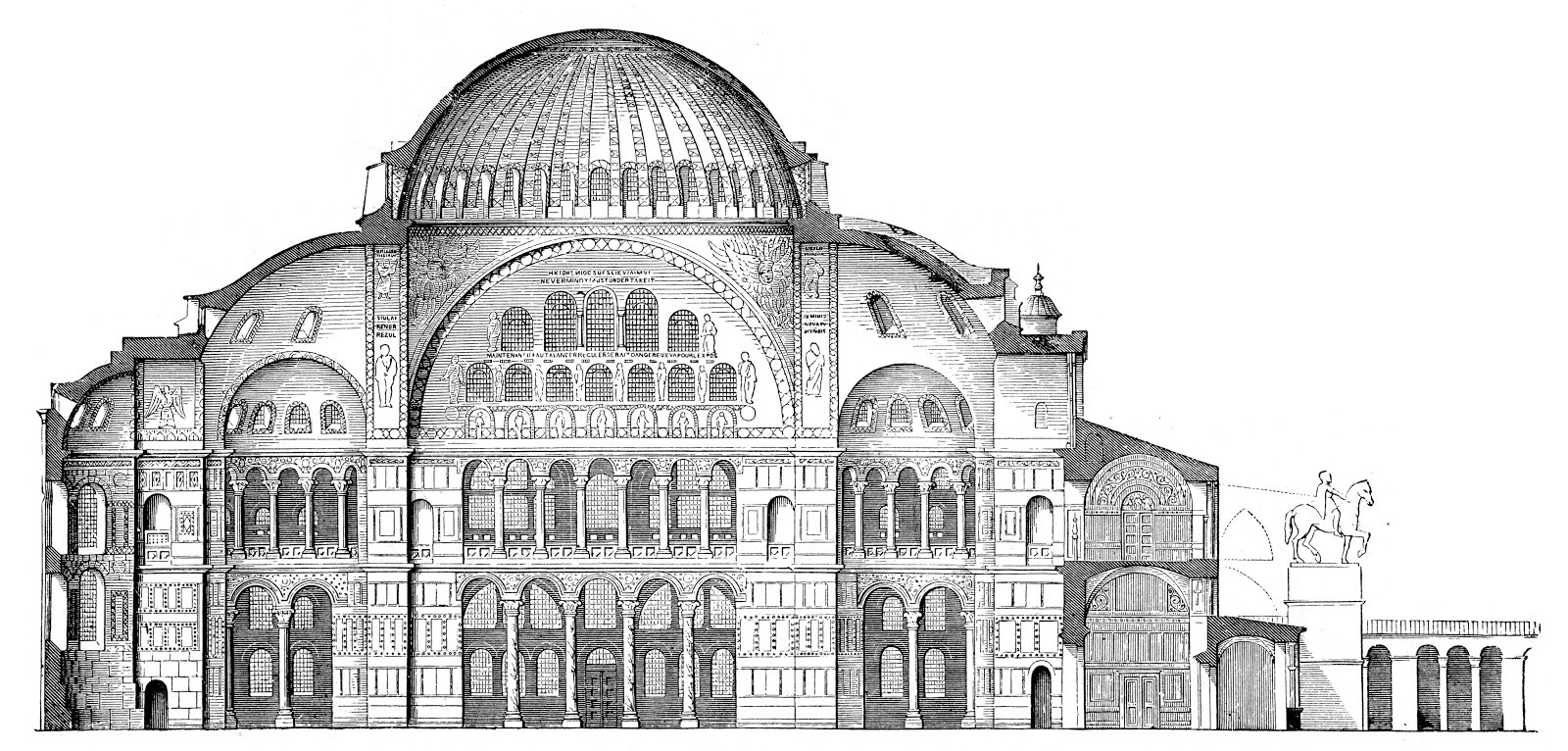
   Architecture was very important to both Islamic and Byzantine cultures. Both have strong examples of excellent architecture, however their methods differ in some ways. The Byzantines with the Hagia Sophia, and the Muslims with the Great Mosque of Kairouan (Mosque of Uqba). The Byzantines had a certain style and sophistication in their architecture that sets them apart from other cultures at the time. Byzantine architecture was more intricate and advanced than that of the Islamic culture.

Primary Sources
Byzantine Primary Source- Hagia Sophia
   My primary source for the Byzantine Empire is the Hagia Sophia. According to an article from Princeton University, The Hagia Sophia was constructed in the year 537 during the Justinian reign. The building has been used in many ways. At the time of its construction, it was an Eastern Orthodox church. Later on it was converted into a Roman Catholic Church and then to a Mosque. The building itself is huge, and is considered to be “the greatest surviving example of Byzantine architecture.” The most important and most marveled part of the Hagia Sophia is it’s central dome. The dome is so important because of its unique design for the time of its creation. It was the first to successfully utilize structures called pendentives, triangular sections of a dome that allow it to merge with a square wall at the base. This is one among many things that make this ancient building so unique.

Islamic Primary Source- Great Mosque of Kairouan (Mosque of Uqba)
    My primary source for the Islamic Civilization is the Great Mosque of Kairouan (Mosque of Uqba). According to an article from Penn State, this Mosque was built in the year 670. At the time, a mosque this size was unheard of. Covering over 9,000 square meters, it is to this day one of the largest Mosques, as well as one of the oldest ones. The Mosque consists of a large courtyard surrounded by many rows of arches, which are considered masterpieces of Islamic Architecture.

Outline
I. Introductory paragraph
II. Body Paragraph 1
i. The Byzantines paid a lot of attention to craftsmanship and design.
A. Design of dome
a. Pendentives
1. First to successfully use them
b. Structure
1. Distribution of weight
X. Collapsed twice
Y. Re-designed- 40 ribs- supports weight
B. Light Reflection surrounding inside of dome
a. Windows
1. Reduces weight
2. Allows light to circulate throughout building
III. Body Paragraph 2
i. The Muslims used mathematics and ratios in their architecture, instead of artistic design.
A. Golden Ratio
a. Found in parts of architectural design
B. Mihrab
a. Mathematically designed to face Mecca
1. Part of their religion
C. Reusing columns from Byzantine buildings
a. Taken from different places
1. Different colors
2. Different Sizes
X. Compensated with the invention of variable bases, capitals and crossbeams
x. Wooden rods connecting columns, enhancing stability
IV. Conclusion Paragraph

MLA Bibliography
"Hagia Sophia." Wikipedia. Wikimedia Foundation, 12 Aug. 2013. Web. 17 Dec. 2013. <http://en.wikipedia.org/wiki/Hagia_Sophia>.

"Mosque of Uqba." Wikipedia. Wikimedia Foundation, 22 Nov. 2013. Web. 18 Dec. 2013. <http://en.wikipedia.org/wiki/Mosque_of_Uqba>.

"Hagia Sophia." Hagia Sophia. Princeton University, n.d. Web. 17 Dec. 2013. <http://www.princeton.edu/~achaney/tmve/wiki100k/docs/Hagia_Sophia.html>.

"Internet History Sourcebooks Project." Internet History Sourcebooks Project. Fordham University, n.d. Web. 15 Dec. 2013. <http://www.fordham.edu/halsall/source/procop-deaed1.asp>.

"Hagia Sophia | Briefing | Professor Ousterhout | Medieval Architecture." Hagia Sophia | Briefing | Professor Ousterhout | Medieval Architecture. N.p., n.d. Web. 18 Dec. 2013. <http://www.learn.columbia.edu/ma/htm/or/ma_or_discuss_hs.htm>.

"The Use of the Golden Section in the Great Mosque at Kairouan | Said Mazouz - Academia.edu." The Use of the Golden Section in the Great Mosque at Kairouan | Said Mazouz - Academia.edu. Academia.edu, n.d. Web. 18 Dec. 2013. <http://www.academia.edu/3418958/The_Use_of_the_Golden_Section_in_the_Great_Mosque_at_Ka

"Table of Contents." Islamic Golden Age. N.p., n.d. Web. 18 Dec. 2013. <http://www.personal.psu.edu/acw5128/Assignment7.html>.

"Late Antiquity." Wikipedia. Wikimedia Foundation, 12 July 2013. Web. 18 Dec. 2013. <http://en.wikipedia.org/wiki/Late_Antiquity>.

"Pendentive." Wikipedia. Wikimedia Foundation, 17 Dec. 2013. Web. 18 Dec. 2013. <http://en.wikipedia.org/wiki/Pendentive>.


Women Fashion Differences

    Women in the Byzantine and Islamic empires dress differently, but the clothing represents the same things in both empires. The Islamic source that will explain the differences is, Women listening from the gallery. Image from the Maqāmāt al-Ḥarīrī. MS Arabe 5847, fol. 58v, detail. Bibliotheque Nationale,Paris.  The Byzantine Empires’s painting is Portrate of a Women in a White tunic. These pictures show the difference in the amount of clothing, the color of clothing and  the difference in why the garment was worn. 

The primary sources are:
Islamic Empire: It is a painting of seven women listing in the gallery. They are all sitting and they all have parts of their faces covered. They all have a lot of cloth around them, covering their entire bodies. This garment is like a cloak, one rectangular piece. Some of the women may be wearing jewelry, others are not.  Most of them have their mouths covered and the rest have their eyes covered. The second and third women from the right look like they are richer because the print is richer and they are wearing more jewelry.  All the women are not smiling. The colors of the wraps are green, yellow, blue or red.

Maqāmāt al-Ḥarīrī. MS Arabe 5847, fol. 58v, detail. Bibliotheque Nationale,Paris.
The Byzantine Empire is a portrait of a woman wearing a loose, white tunic with a boat shaped collar. The women is wearing hoop earrings with small pearls. Her head and face is not covered to show that her hair is parted in the middle and pulled back. There is a burnt red strap on her right shoulder. According to my research, from an article by Dawn Vukson - Van Beek, the woman's tunic tells us that she is of the lower class. The tunica was the underclothes in the winter and sometimes the actual garment in the summer. It normally would have been warn under a stola, which is like an over coat.

Portriat of a Woman in a White Tunic
Outline:
1. The Islamic women are more confined in what they have to wear, like having to be complacently covered     up.
     a) Why this type of clothing, and why wear it like that?
            ii. The Norm: It was normal for women to cover themselves and submit themselves to men. In some                   places in Turkey, women were held higher than men, and to travelers, it seemed unnatural. The                     women in the painting had their faces covered form the men in the gallery.
     b) How does the clothing show class and wealth?
            i. Jewelry: The jewels on women 2,3, and 6 bodies and clothes indicated that they were of a higher                 class, because they can afford the jewels. In the Medieval time, jewelry was mainly for the men, but               the richer women could wear it as well.
           ii. Cloth Patterns: The patterns on the cloth was more elaborate, meaning more expensive on women                  2,3, and 6, also showing that they were of a richer class than the other women.

2. The Byzantine women are much more freer in the type of garment, because they do not have to cover           their faces and can be seen in public in a tunic, or essentially an undergarment.
      a) Why this type of clothing, and why wear it like that?
            i. Versatility: Tunics were the Byzantine people's staple garment, much like our pair of jeans. Made                  either of fine wool, silk or linen. They were the underclothes for the rich or the common for the                      poor or working class.
           ii. Comfort: Most always the tunic was white, making it cooler in the Mediterranean heat.                                 Occasonaly, the tunic would be sleeveless, also to make it cooler. It would normally go under a                     stola, or embellished over coat, for the richer people.
     b) How does the tunic show class and wealth?
           i. The material: If it was made of silk, the wearer was probably rich. The tunic in the painting is                         linen, or fine wool showing that the woman is of the lower class.
           ii. The style: The more embellishments that are on the tunic, the richer the person is. So, because there                are no trimming, the women was lower class. Also, if the tunic is being warn as an undergarment,                  then there is a stola, which is not present.

3. The Byzantine women are more freer, than the Islamic women based on the style of clothing, but the             clothing is used as a symbol of wealth in both Islamic and Byzantine cultures.
      a) Why Byzantine are freer.
            i.  No head coverings: The Byzantine women do not have to have their heads and faces covered up.                 In the Byzantine empire, it was very rare for a woman to wear a hat, or anything on her head.
            ii. Bodily  Coverage: The Muslim women had almost every inch covered up, but the tunics could be                  sleeveless, leaving the arms exposed, along with the neck because of the boat shaped                                    neckline.Unlike the Muslim women who had their necks covered as well.
      b) How they are similar
            i. They represented wealth: If a woman had a more expensive fabric, like silk, or a more elaborate                    fabric, then the woman was most likely from the upper class.
            ii. If a woman had more jewelry, or more embellishments, signified a wealthier class.

Works Cited
Vukson-Van Beek, Dawn. "Byzantine Costumes." N.p., n.d. Web. 19 Dec. 2013.                        <http://library.thinkquest.org/04oct/01181/Byzantine%20costume.pdf>.
"Women in Islam: Muslim Women." Women in Islam: Muslim Women. N.p., n.d. Web. 19 Dec. 2013. <http://islam.uga.edu/Islamwomen.html>.
Al-Kaslaania, Samia. "Sayyeda Al-Kaslaania's Fatimid Arts." : Medieval Islamic Cloak-type Wraps:Material Culture Fourteen: A&S 50 Challenge. N.p., 29 Mar. 2010. Web. 19 Dec. 2013.                 <http://idlelion.blogspot.com/2010/03/50-challenge-material-culture-fourteen.html>.
Mann, Horace. "Part I: What Do the Qur'an and Hadith Have to Say about Muslim Clothing?"Muslim and Middle Eastern Clothing, Jewelry, Make-up. N.p., n.d. Web. <http://www.hudsoncress.net/hudsoncress.org/html/library/nonfiction/Islamic%20Clothing.pdf>.
Portrait of a Woman in a White Tunic. 4th Century. Photograph. Joseph Brummer Gallery, New York.
Women Listening from a Gallery. 5847. Photograph. Bibliotheque Nationale, Paris.

Religious influences on social classes in the Byzantine Empire and Islamic Civilazation


I. Religion is a topic that many wars have been fought over and break bonds that you once thought was inseparable. Religion is though to be a way of life, but some cultures choose to eliminate public displays of religion to keep tension to a minimum. The ancient Byzantine Empire displays this in a very public way, social class. This empire wants to focuses on more important things; money and political standings. On the polar opposite site we have the Islamic civilization whose citizens' daily life revolves around their religion. The social class system of the Islamic civilization was solely determined by religious status, one’s religion determined their social standing; while Byzantine social hierarchy was based on economic and political factors, one’s monetary wealth and ministerial influence.

II.  Islamic Social Structure
               A.  The Islamic social hierarchy was only constructed around Islam.
                            1. How the classes were divided
                                         a. Birth into Islam, converted, protected people, non-muslims
                            2. Acceptance towards other religions
                                         a.   Primary Source:
                                                 1. According to the Sahih International, the Quran, 2:62, says The people who are actively practicing Judaism, Christianity, and Seboghatullah should not be punished for not following the Muslim ways. For the people who did follow Allah will be rewarded. They will not be rewarded with material things, but with the grace of Allah. Their lord's grace shall bless them, and they will not feel pain or sorrow.
                                         b. Expected people to follow the Quran during daily life
                                         c. Peaceful society
II. Byzantine Social Class
                 A. The Byzantine Empire focus their social structure on money and political standings instead of religion.
                            1. How the Classes were divided
                                          a. Top, Senatorial Class-has at least one noble in the family, someone who has served in the Senate before, Equestrian Class- Had a stable income,land worth 400,000 sesterces, Family was also considered Equestrian also, Commons- Born a citizen, lower class,Foreigners- Lived in the territories,Freed People- people who used to be slaves but not anymore, and Slaves
                             2. Separated the top classes from the bottom
                                           a. Law that divided Romans into two groups, the honestiores more honorable people including senators, equestrians, and soldiers and the humiliores more insignificant people including all other groups
b. Clothing represented social class
i. Primary Source-
 
                                                 In this mosaic,there are four men dressed in white long robes, but with different garments on top of the white. The men are surrounding a haloed man wearing purple. The remaining four men look to be serving the purple roped man. According to Dr. Steven Zucker, Justinian I is wearing a purple robe and is crowned with a halo. He is surrounded with members of the church and the Bishop Maximianus of Ravenna. On the left of the painting you can see men wearing a white rope with a purple stripe across their torso.The painting represents the "Central Position of the Emperor between the power of the church and the power of the imperial administration and military." It re-enforces the idea that Justinian I has power over the religion, military, and country.
                                                                   ii. Purple Signified Emperor and Stripes signified Soldier

Work Cited:
McManus, Barbara F. "Roman Social Class and Public Display." Roman Social Class and Public Display. The College of New Rochelle, Jan. 2009. Web. 18 Dec. 2013. <http://www.vroma.org/~bmcmanus/socialclass.html>.
Rautman, Marcus Louis. Daily Life in the Byzantine Empire. Westport, Conn. [u.a.: Greenwood, 2006. Print.
"Surat Al-Baqarah." Surat Al-Baqarah [2:59-65]. University of Copenhagen, Nov. 2007. Web. 19 Dec. 2013. <http://quran.com/2/59-65>.
Zaheer, Khalid, Dr. "Qur’an: The Primary Source of Islam." Qur’an: The Primary Source of Islam. N.p., n.d. Web. 19 Dec. 2013. <http://www.renaissance.com.pk/janqur99.html>.

Byzantine and Islamic Art and Religion


The Byzantine Empire and the Islamic religious cultures are similar and different in several different aspects. In the Byzantine Empire, they incorporated art into their religion by using very elaborate decorated crosses in imperial processions, and even in the military. The Islamic peoples also used art in their religion, but they mostly were paintings of significant events in their religion. The Byzantine Empire focused on using their crosses and religious art in imperial processions and in the military, but the Islamics used their art in their religion mainly with paintings of significant events in history of the religion.

The Byzantine Cross is extravagantly decorated with silver and gold busts of Christ, the Virgin Mary, the Mother of Christ, John the Forerunner, and Michael and Gabriel (the guardian angels of heaven). The bust of Christ is placed in the center, and the rest of the figures are placed on each end of the cross. These were very important to the Byzantines and the Christian religion during that time period.
The Islam painting is of Muhammad's Call to Prophecy and the First Revelation. The writing around the picture, it explains that the angel is Gabriel, and he is in God’s presence being told to send a message.
  1. The Byzantine Empire used crosses and their religious arts in military, and imperial processions.
    1. Their crosses would also be used as donations to cure sicknesses and purify water.
      1. Saints are mostly the ones who used these type of crosses in imperial processions and other ceremonies.
    2. The crosses would be taken with the military when they went of to war. It would be used as a “protector”, or it could be used if one of the soldiers became ill or wounded to help them get better.
    3. These crosses were very important to the Byzantine Empire, their religion, and had a major effect on how the Byzantine people they lived their lives.
  2. The Islamic people used art in their religion with mostly paintings of significant events.
    1. The Islam religion did not use art in any religious ceremonies or imperial processions like the Byzantines did.
    2. Instead, they have several historic paintings that honor their Allah.
      1. These painting could also be used to teach others about their religion and to keep the Islamic religion in their minds.
    3. The Islamic did not use their art in religious ceremonies like the Byzantines, but they had other ways that their religion related to their art.
  3. Even though the Byzantine Empire used art more with their religion than the Islamics did, they still both had some similarities.
    1. Both of the religions used their form of art to honor their God and to help keep the religion in their minds.
  4. The Byzantine Empire over all incorporates their art and religion more and in different ways than the Islamic Culture.


Works Cited
"Heilbrunn Timeline of Art History." The Birth of Islam. N.p., n.d. Web. 17 Dec. 2013.
"Heilbrunn Timeline of Art History." Processional Cross [Byzantine] (1993.163). N.p., n.d. Web. 18 Dec. 2013.
"404." 404. N.p., n.d. Web. 18 Dec. 2013.


Roshni Patnayakuni

Women's Clothing:

Islam vs. The Byzantine Empire    
       In  Islam, modesty was an important trait, especially in women; In the bible it says that it should be for Christian women as well though for different reasons. In the Qu'ran it demanded modesty to avoid being risque, while in the bible it spoke of humility and self-control to let your inner beauty shine through. Though still, despite the similarity in rules, the clothing was actually quite different; the dress code of the Muslim people was much stricter than that of the Byzantine Empire. This shows that religion was taken much more seriously in Islam than in the Byzantine Empire.

Paraphrasing:

“O you Children of Adam! We have bestowed on you raiment to cover your shame as well as to be an adornment to you. But the raiment of righteousness, that is the best. Such are among the Signs of Allah, that they may receive admonition.” (Quran 7:26)
“And say to the believing women that they should lower their gaze and guard their modesty; that they should not display their beauty and ornaments except what must ordinarily appear therof; that they should draw their veils over their bosoms and not display their beauty except to their husbands, their fathers, their husbands’ fathers, their sons, their husbands’ sons, their brothers, or their brothers’ sons or their sisters’ sons, or their women or the servants whom their right hands possess, or male servants free of physical needs, or small children who have no sense of the shame of sex, and that they should not strike their feet in order to draw attention to their hidden ornaments…” (Quran 24:31).
            
These chapters in the Qu’ran basically states that they have clothing therefore it should be used to exercise modesty. Though it can be a decoration a worshipper’s religion is be the best  embellishment. It also says that women should “guard their modesty” by not showing their bodies or any additional adornment besides the necessary basics. They should wear scarves that cover their heads and drape all the way down to the neckline on their clothes to hide the neck and collar area as well. There are only select people who they don’t have to where this outfit in front of: their parents, their siblings, their children, their sibling’s children, their in-laws, small (innocent) children and certain servants. As well, they must not stomp to bring awareness to the jewelry they wear under their clothes

likewise also that women should adorn themselves in respectable apparel, with modesty and self-control, not with braided hair and gold or pearls or costly attire,  but with what is proper for women who profess godliness—with good works. (Timothy 2:9-10)
Your beauty should not come from outward adornment, such as elaborate hairstyles and the wearing of gold jewelry or fine clothes.  Rather, it should be that of your inner self, the unfading beauty of a gentle and quiet spirit, which is of great worth in God’s sight. (Peter 3:3-4)
…. and be clothed with humility: for god resisteth the proud, and giveth grace to the humble.

In the bible it says that women should dress “with modesty and self-control” meaning they shouldn’t wear revealing clothes or clothes or jewelry with excessive embellishment; Christian women should do this so that their inner beauty (AKA their sparkling personalities) will shine through.  It says that god blesses the humble, not the vain.

Outline:

  • Introduction( see opening paragraph)
    • Despite the regulations about modesty in the religious texts of both Iran and The Byzantine Empire, the dress code of the Muslim people was much stricter than that of The Byzantine Empire. This shows that religion was taken much more seriously in Islam than The Byzantine Empire.
  • 1st Paragraph: Religious Clothing in Islam vs. Real Clothing in Islam
    • very similar
      • wear their veils properly and conservatively
      • wear dull colors: modest colors
      • hide ornamentation under clothing
  • 2nd Paragraph: Religious Clothing in Byzantine vs. Real Clothing in Byzantine
    • rule bending/ possible breaking
      • bright colors
      • some adornment
      • wore headscarves but much looser and less constricting
      • interest in fashion
  • Conclusion
    • what is actually done in Islam was very close to what was demanded in the Qu'ran, while in the Byzantine empire, the clothes that were worn were very different from the rulings of the bible.
    • therefore the rulings of religion are taken much more serious in Islam than in the Byzantine Empire.

Works Cited:
Robinson, Scott. "Romanesque/Byzantine."Romanesque/Byzantine. Central Washington University, 1 May 2002. Web. 18 Dec 2013
       <http://www.cwu.edu/~robinsos/ppages/resources/Costume_History/romanesque.htm>.